From Narrow AI to AGI: Types of AI, Technical Architectures, and How We Achieve Artificial General Intelligence
The question of Artificial General Intelligence (AGI) has transitioned from the speculative realm of theoretical philosophy into the epicenter of modern computer science and enterprise software engineering. Across research labs and industry engineering teams in 2026, the discussion is no longer *if* AGI is achievable, but *how* the underlying software architectures, compute scaling laws, and cognitive paradigms are converging to create human-level and superhuman systems.
To understand the trajectory of autonomous software, developers and technology executives must first understand the fundamental Types of AI, the 5 Levels of AGI Progression, and the 5 Concrete Technical Breakthroughs currently bridging the gap between narrow statistical pattern-matchers and genuine general problem-solvers.
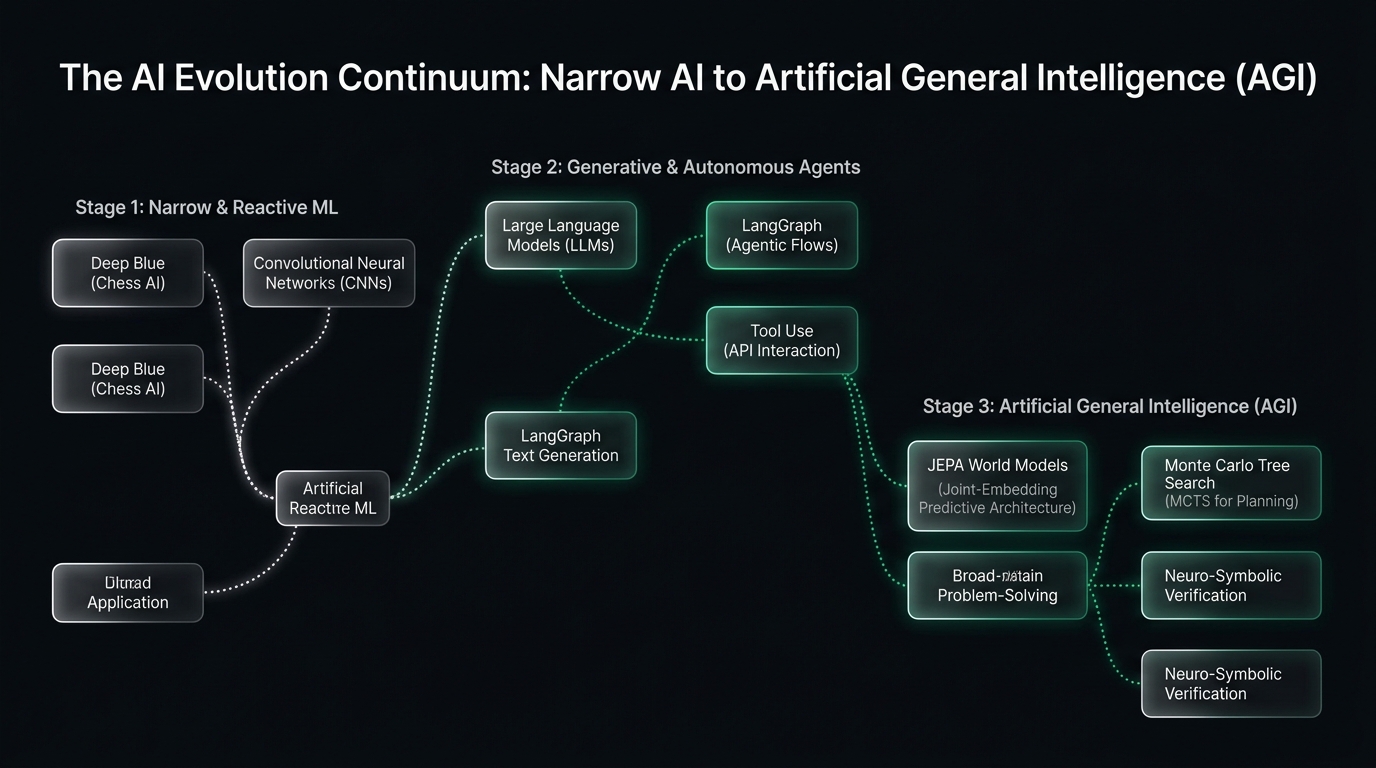
1. Reactive Machines (Type 1)
The most basic form of AI. Reactive machines have no concept of past memory, cannot learn from previous interactions, and operate strictly on deterministic inputs mapping to pre-computed outputs (e.g., IBM's Deep Blue chess engine or rule-based spam filters).
2. Limited Memory & Narrow AI (Type 2)
Narrow AI systems leverage historical training datasets to make statistical predictions within tightly constrained domains. Examples include convolutional neural networks (CNNs) for medical imaging, fraud detection classifiers in banking, and recommendation algorithms on Netflix. While exceptional at their single task, they possess zero generalizability to adjacent domains.
3. Generative Foundation Models (Type 3)
The generative wave powered by dense Transformers (GPT-3.5, GPT-4, Llama 3). These models ingest vast internet-scale corpora to generate text, code, audio, and imagery. However, early generative models operate as "System 1" rapid intuitive predictors—generating tokens without forward planning or continuous verification.
4. Autonomous Agentic AI (Type 4)
The current state of production enterprise engineering in 2026. Autonomous agentic systems combine generative foundation models with stateful graph orchestration, external tool calling (APIs, SQL, bash), self-correcting feedback loops, and human-in-the-loop (HITL) controls (see our deep dive on Agentic RAG and Multi-Agent Orchestration).
5. Artificial General Intelligence (AGI) & Superintelligence (ASI) (Type 5)
A software system capable of matching or exceeding human cognitive performance across virtually all economically and scientifically valuable work. An AGI system independently forms hypotheses, invents new algorithms, adapts to entirely novel environments without human fine-tuning, and manages complex organizations autonomously.
Part 2: The 5 Levels of AGI (OpenAI & DeepMind Taxonomy)
To establish empirical milestones, leading research organizations have formalized the 5 Levels of Autonomous AI progression:
| AGI Level | Designation | Defining Capability | Real-World Benchmark | Current Status (2026) |
|---|---|---|---|---|
| Level 1 | Conversationalists | Natural conversational language & broad factual recall | Standard LLMs (GPT-3.5, Gemini 1.0) | Fully Solved (2023) |
| Level 2 | Reasoners | Human-level problem solving in competitive STEM & coding | OpenAI o1/o3, DeepMind AlphaProof | Fully Solved (2024–2025) |
| Level 3 | Agents | Multi-day autonomous task execution & tool orchestration | DevGenXai Multi-Agent Pods, SWE-Agent | In Active Production (2026) |
| Level 4 | Innovators | Generating original scientific discoveries & novel math proofs | Automated scientific research labs | Emerging in Labs (2026–2027) |
| Level 5 | Organizations | Entire autonomous organizations executing end-to-end businesses | Autonomous enterprise coordination | Research Horizon (2028+) |
Part 3: The 5 Engineering Breakthroughs: How We Achieve AGI
Moving from Level 3 Agentic Systems to Level 4/5 True AGI requires solving five fundamental computer science bottlenecks that cannot be resolved merely by adding more web-scraped text tokens to pre-training:
1. Test-Time Compute Scaling & Tree of Thoughts (ToT)
Instead of predicting the next token in 20 milliseconds, AGI architectures allocate variable inference compute to explore branching search trees (Monte Carlo Tree Search with Value Networks), simulating dozens of intermediate logical paths and verifying self-consistency before returning a conclusion.
2. Joint Embedding Predictive Architectures (JEPA World Models)
As articulated by Turing Award winner Yann LeCun (Meta Chief AI Scientist), generative pixel-level and text-level prediction suffers from exponential error accumulation. JEPA architectures learn world models in abstract representation space, allowing an AI agent to predict the *consequences* of its actions without generating irrelevant low-level details.
3. Persistent Episodic & Procedural Memory
Current LLMs suffer from catastrophic forgetting once context windows are cleared. True AGI incorporates a continuous memory consolidation pipeline:
- Working Memory: Dynamic attention buffer (RAM).
- Episodic Memory: Vectorized graph of past user interactions and environmental states.
- Procedural Memory: Compiled skill libraries of successful code patterns and API interaction strategies stored in immutable databases.
4. Neuro-Symbolic Integration & Formal Verification
Neural networks are probabilistic and prone to subtle hallucinations. Symbolic systems (like Lean 4, Coq, and Z3 SMT solvers) are deterministic and mathematically rigorous. Combining deep neural generators with symbolic formal verifiers eliminates hallucinations in mission-critical software engineering, medicine, and aviation.
5. Autonomous Self-Improving & Self-Healing Code
The hallmark of AGI is recursive self-improvement: an AI system that profiles its own latency bottlenecks, writes unit tests, optimizes its algorithms in Rust/C++, and redeploys its containers with zero human intervention.
Part 4: Production Architecture: Neuro-Symbolic Reasoning Engine
Below is a production-grade Python implementation of a Deliberative System-2 Reasoning Node combining tree exploration with deterministic verification checks:
# Neuro-Symbolic Deliberative Reasoner for Autonomous Decision Verification
import asyncio
from typing import List, Dict, Any, Callable
from dataclasses import dataclass

@dataclass
class CandidateHypothesis:
    id: str
    reasoning_path: List[str]
    proposed_action: Dict[str, Any]
    confidence_score: float
    is_verified: bool = False

class NeuroSymbolicAGIEngine:
    def __init__(self, verifier_fn: Callable[[Dict[str, Any]], bool]):
        self.verifier = verifier_fn
        self.episodic_memory: List[Dict[str, Any]] = []

    async def generate_thought_branches(self, problem_state: Dict[str, Any], branches: int = 3) -> List[CandidateHypothesis]:
        """
        Simulates Monte Carlo Tree Search branch generation across distinct reasoning paths.
        """
        await asyncio.sleep(0.05)
        return [
            CandidateHypothesis(
                id="hyp_01",
                reasoning_path=["Analyze query complexity", "Direct query to primary PostgreSQL replica", "Execute batch read"],
                proposed_action={"method": "DIRECT_QUERY", "target": "replica_01", "risk": "low"},
                confidence_score=0.88
            ),
            CandidateHypothesis(
                id="hyp_02",
                reasoning_path=["Detect high write contention", "Initialize distributed Redis lock", "Queue message to BullMQ"],
                proposed_action={"method": "ASYNC_QUEUE", "target": "redis_cluster", "risk": "zero"},
                confidence_score=0.96
            )
        ]

    async def evaluate_and_verify(self, candidates: List[CandidateHypothesis]) -> CandidateHypothesis:
        """
        Applies deterministic symbolic constraints to filter and select the safest candidate.
        """
        verified = [c for c in candidates if self.verifier(c.proposed_action)]
        verified.sort(key=lambda x: x.confidence_score, reverse=True)
        winner = verified[0]
        winner.is_verified = True
        return winner
Summary & Looking Forward: 2026 to 2030
The transition from statistical next-token prediction to deliberative reasoning, world models, and recursive neuro-symbolic verification is unfolding now. Companies that build on modern agentic frameworks and multi-model architectures will own the foundational infrastructure of the AGI era.
Part 5: Enterprise Roadmap: Preparing Your Stack for AGI
Building software in the era of rapid AGI progression requires modular, decoupled architectures. Systems that hardcode rigid rules will become obsolete; systems built with stateful APIs, clean semantic contracts, and robust multi-tenant data isolation will seamlessly scale as frontier intelligence multiplies.
Key engineering priorities for 2026:
- Expose Every Business Process as a Clean Tool API: If an agentic system cannot read your inventory, trigger your ERP webhooks, or inspect your CRM state via OpenAPI contracts, it cannot automate your business.
- Implement Row-Level Security & Zero-Trust IAM: When autonomous agents execute thousands of tasks hourly, strict database-level security policies (e.g., PostgreSQL RLS) are mandatory to prevent cross-tenant data leaks.
- Monitor with End-to-End LLMOps Tracing: Implement comprehensive observability (LangSmith, OpenTelemetry) to track reasoning accuracy, latency budgets, and agent tool execution success rates.
At DevGenXai, our New York engineering team specializes in building production systems that leverage state-of-the-art agentic AI. Explore our enterprise AI development services, read our case studies on clinical document AI, or book a 30-minute scoping call with our senior architects.

Founder & Lead Technical Architect at DevGenXai. Enterprise software specialist with 8+ years building high-concurrency web platforms, autonomous AI workflows, and cloud backends for global clients.
Book a 30-minute technical consultation with senior lead Jawad Abbas to review your architecture and roadmap.
Schedule Technical CallMore Engineering Publications
GPT-6 Astra & Frontier Foundation Models: Architecture, Test-Time Compute, and Enterprise Deployment
An exhaustive technical teardown of GPT-6 Astra: Mixture of Depths (MoD), dynamic test-time reasoning tokens, sub-quadratic attention, and enterprise API deployment strategies for production software architectures.
Agentic RAG & Multi-Agent Orchestration: From Naive RAG to Autonomous Production Systems
Naive RAG is dead in enterprise production. Explore how top software engineering teams are combining multi-agent graph orchestration with self-correcting RAG loops. Grounded in peer-reviewed research (Lewis et al., Yao et al., Wu et al.) and visionary insights from Andrej Karpathy and Sam Altman.
From Pilots to Production: Measuring Real ROI of AI Automation in 2026
Stop settling for AI experiments. Learn how to transition from pilot projects to production-grade AI systems with measurable operational ROI.